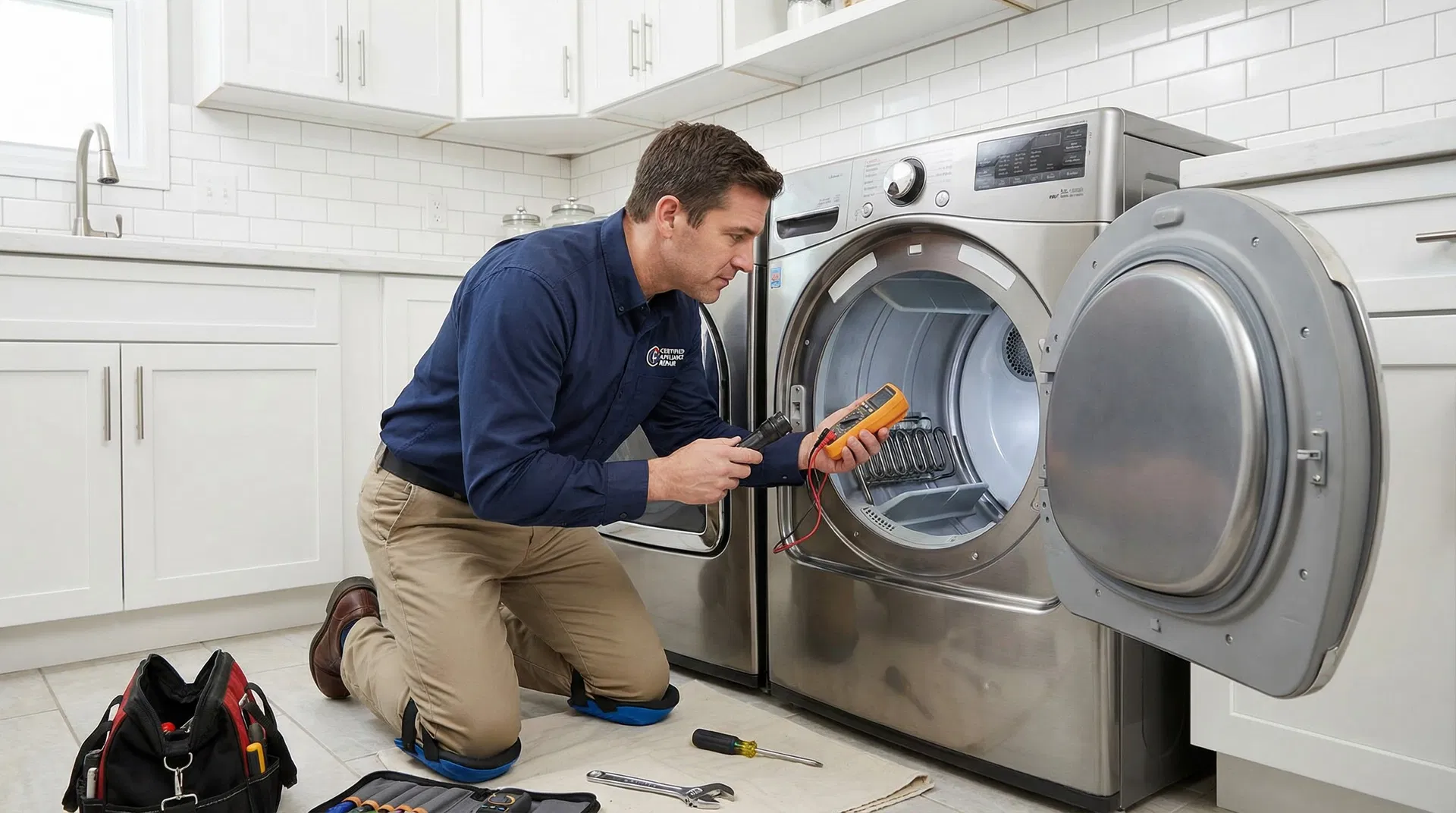
TL;DR (Too Long; Didn't Read)
If your dryer runs but produces no heat, the problem is almost always an airflow issue preventing hot air circulation. The most common causes are a clogged dryer vent (60% of cases), a blown thermal fuse (safety device that breaks when dryer overheats), or a broken heating element (electric dryers) or faulty igniter (gas dryers). Less common causes include a tripped circuit breaker or faulty thermostat.
Quick DIY checks: Clean your lint filter and exhaust vent, check your breaker box (electric dryers use 240V split across two breakers), and listen for the igniter clicking (gas dryers). Most repairs cost $100-$300 and are completed in one visit. If your fridge has been warm for more than 6 hours, you're losing $15-30 per hour in spoiled food. Same-day appointments available.
When to call immediately: If your dryer smells like burning, makes grinding noises, or has been overheating frequently—these are fire hazards requiring immediate professional attention.
🚨 NEED IMMEDIATE HELP?
Call (321) 559-0933 Now for Same-Day Service
✓ Answer in 30 seconds or less
✓ Same-day appointments available
✓ Most repairs completed in one visit
✓ 90-day warranty on all repairs
✓ 15+ years in business | 2,100+ verified customers
Don't wait—clogged vents are a leading cause of house fires!
Understanding Your Dryer: Gas vs Electric
Before diagnosing the problem, it's critical to know whether you have a gas dryer or an electric dryer—they use completely different heating systems and have different failure points.
Electric Dryers
Electric dryers use a heating element (metal coils that glow orange-red when working) powered by 240 volts. The element heats air that's blown through the drum by a fan. When the heating element breaks (similar to a lightbulb filament burning out), the dryer will run normally but produce no heat.
Key components:
- Heating element coils
- Thermal fuse (safety device)
- High-limit thermostat
- Cycling thermostat
Gas Dryers
Gas dryers use an igniter and gas burner assembly to create heat. When you start the dryer, the igniter glows white-hot to light the gas burner. If the igniter is weak or broken, it won't light the gas, and the dryer will run cold.
Key components:
- Gas igniter
- Gas valve coils
- Flame sensor
- Thermal fuse
How to tell which type you have: Look at the back of your dryer. If there's a thick power cord (like a stove), it's electric. If there's a gas line connection, it's gas.
The 6 Most Common Causes of a Dryer Not Heating
1. Clogged Dryer Vent (60% of Cases)
What it is: Lint accumulates in the exhaust vent pipe over time, blocking airflow. When airflow is restricted, the dryer overheats, triggering the thermal fuse to blow as a safety measure.
Symptoms:
- Clothes take 2-3 cycles to dry
- Dryer feels very hot to touch
- Burning smell
- Lint visible around dryer door
DIY Fix: Disconnect the vent hose from the back of the dryer and vacuum out lint. Use a dryer vent cleaning brush (available at hardware stores) to clean the entire vent pipe from dryer to exterior vent. Check the exterior vent flap to ensure it opens freely.
Professional Repair Cost: $100-$150 for professional vent cleaning
Fire Risk: Clogged dryer vents cause an estimated 15,000 house fires per year. If your vent hasn't been cleaned in over a year, schedule professional cleaning immediately.
2. Blown Thermal Fuse (30% of Cases)
What it is: The thermal fuse is a one-time safety device that "blows" (breaks the electrical circuit) when the dryer overheats. Once blown, it cannot be reset—it must be replaced.
Symptoms:
- Dryer runs but produces zero heat
- No burning smell or unusual noises
- Often caused by clogged vent (see #1)
DIY Fix: The thermal fuse is located on the blower housing or heating element housing. Use a multimeter to test for continuity (should read 0-0.1 ohms). If there's no continuity, the fuse is blown and must be replaced. Important: If you don't also clean the vent, the new fuse will blow again.
Professional Repair Cost: $100-$150 (includes fuse + labor)
Part Cost (DIY): $10-$20
3. Broken Heating Element (Electric Dryers Only)
What it is: The heating element is a coil of wire that glows orange when electricity passes through it. Over time, the coil can break (similar to a lightbulb filament), stopping heat production.
Symptoms:
- Dryer runs but no heat
- No visible glow from heating element (if you can see it)
- May have worked intermittently before failing completely
DIY Fix: Access the heating element housing (usually at the front or back of the dryer). Use a multimeter to test for continuity (should read approximately 10 ohms). If there's no continuity or infinite resistance, the element is broken and must be replaced.
Professional Repair Cost: $150-$300 (includes element + labor)
Part Cost (DIY): $30-$80
4. Tripped Circuit Breaker (Electric Dryers Only)
What it is: Electric dryers use 240 volts, which requires two 120-volt breakers working together. If one breaker trips, the dryer will receive only 120 volts—enough to run the motor and drum, but not enough to power the heating element.
Symptoms:
- Dryer runs normally but produces no heat
- Happened suddenly (not gradual)
- May have occurred after a power surge
DIY Fix: Go to your breaker box and look for the dryer circuit (usually labeled, often a double breaker). Important: Don't just flip it back on. First, flip BOTH breakers completely OFF, then flip them both back ON. This ensures both legs of the 240V circuit are properly reset.
Professional Repair Cost: Free (DIY fix)
When to call an electrician: If the breaker trips repeatedly, you may have a short circuit in the dryer or wiring, which requires professional diagnosis.
5. Faulty Gas Igniter (Gas Dryers Only)
What it is: The igniter is a small ceramic component that glows white-hot to light the gas burner. Over time, igniters weaken and can no longer reach the temperature needed to open the gas valve.
Symptoms:
- Dryer runs but no heat
- You can hear clicking but no flame
- Igniter glows faintly orange instead of bright white
DIY Fix: Access the burner assembly (usually behind the front panel). Observe the igniter when the dryer is running. If it glows but the gas doesn't light, the igniter is weak and must be replaced. Safety warning: If you smell gas, turn off the gas supply immediately and call a professional.
Professional Repair Cost: $150-$250 (includes igniter + labor)
Part Cost (DIY): $25-$50
6. Faulty Thermostat or Limit Switch
What it is: Thermostats regulate the dryer's temperature by cycling the heating element on and off. The high-limit thermostat is a safety device that cuts power to the heating element if the dryer overheats.
Symptoms:
- Dryer runs but no heat
- May work intermittently
- Often caused by restricted airflow
DIY Fix: Use a multimeter to test thermostats for continuity at room temperature (should have continuity). If there's no continuity, the thermostat is faulty and must be replaced.
Professional Repair Cost: $120-$200 (includes thermostat + labor)
Part Cost (DIY): $15-$40
Cost Breakdown: Repair vs Replace
| Repair Type | Professional Cost | DIY Cost | Time to Complete |
|---|---|---|---|
| Vent Cleaning | $100-$150 | $20-$30 (brush) | 1-2 hours |
| Thermal Fuse | $100-$150 | $10-$20 | 30-60 minutes |
| Heating Element | $150-$300 | $30-$80 | 1-2 hours |
| Gas Igniter | $150-$250 | $25-$50 | 1-2 hours |
| Thermostat | $120-$200 | $15-$40 | 30-60 minutes |
| New Dryer | $400-$1,200 | N/A | Delivery + install |
Repair vs Replace Decision Framework
✅ REPAIR if:
- Dryer is less than 7 years old
- Repair cost is under $300
- Dryer has no other issues
- You've maintained it regularly
❌ REPLACE if:
- Dryer is over 10 years old
- Repair cost exceeds $300
- Multiple components failing
- Dryer has been unreliable
🤔 EVALUATE if (7-10 years old):
- Repair cost under $200: Repair
- Repair cost $200-$300: Consider energy efficiency of new models
- Repair cost over $300: Replace
Energy savings: New Energy Star dryers use 20% less energy than 10-year-old models, saving approximately $20-$30 per year on utility bills.
Brand-Specific Issues
Samsung Dryers
- Common problem: Heating element failure due to moisture sensor malfunction
- Symptom: Dryer stops mid-cycle or runs cold
- Fix: Replace moisture sensor bar ($30-$50 part)
LG Dryers
- Common problem: Thermal fuse blows frequently due to vent design
- Symptom: Dryer works for a few months, then stops heating again
- Fix: Professional vent rerouting + thermal fuse replacement
Whirlpool/Maytag Dryers
- Common problem: Thermal cut-off fuse on blower housing
- Symptom: Dryer runs but no heat, even with clean vent
- Fix: Replace thermal cut-off fuse ($15 part)
GE Dryers
- Common problem: Heating element breaks at connection point
- Symptom: Intermittent heat, then complete failure
- Fix: Replace entire heating element assembly
DIY Troubleshooting Steps (In Order)
Step 1: Clean the Lint Filter and Vent
Remove lint filter and vacuum the filter slot. Disconnect the vent hose and clean it thoroughly. Check the exterior vent for blockages.
Time: 30-60 minutes
Tools needed: Vacuum, dryer vent brush
Step 2: Check the Circuit Breaker (Electric Dryers)
Go to your breaker box. Flip both dryer breakers completely OFF, then back ON.
Time: 2 minutes
Tools needed: None
Step 3: Test the Igniter (Gas Dryers)
Start the dryer and listen for clicking. Open the front panel and observe the igniter. It should glow bright white within 30 seconds. If it glows faintly or not at all, it needs replacement.
Time: 10 minutes
Tools needed: Screwdriver
Step 4: Test the Thermal Fuse (Electric Dryers)
Unplug the dryer. Access the thermal fuse (location varies by model—check your manual). Use a multimeter set to ohms. Touch probes to both terminals. Should read 0-0.1 ohms. If it reads infinite resistance, the fuse is blown.
Time: 30 minutes
Tools needed: Multimeter, screwdriver
Step 5: Test the Heating Element (Electric Dryers)
Access the heating element housing. Use a multimeter to test for continuity (should read approximately 10 ohms). Visually inspect for broken coils.
Time: 45 minutes
Tools needed: Multimeter, screwdriver
Safety Warnings
🔥 Fire Hazards
- Lint buildup: Clean your lint filter after every load and have your vent professionally cleaned annually
- Overheating: If your dryer feels extremely hot to touch, stop using it immediately
- Burning smell: Turn off dryer and unplug it. Call a professional.
⚡ Electrical Hazards
- Always unplug the dryer before opening panels or testing components
- 240V shock risk: Electric dryers use high voltage that can be fatal
- Gas leaks: If you smell gas, turn off the gas supply and call a professional immediately
Preventive Maintenance to Avoid Future Problems
Monthly:
- Clean lint filter after every load
- Inspect exterior vent flap for blockages
- Wipe down moisture sensors with rubbing alcohol
Every 6 Months:
- Vacuum behind and under the dryer
- Check vent hose for kinks or damage
- Test dryer for proper heating
Annually:
- Professional vent cleaning
- Inspect heating element for wear
- Test thermal fuse and thermostats
Average dryer lifespan: 10-13 years with proper maintenance
Frequently Asked Questions
Q: Why does my dryer run but not heat?
A: The most common cause is a clogged dryer vent (60% of cases), which triggers the thermal fuse to blow as a safety measure. Other causes include a broken heating element, tripped circuit breaker, or faulty igniter (gas dryers).
Q: How much does it cost to fix a dryer that's not heating?
A: Most repairs cost $100-$300 depending on the part. Thermal fuse replacement costs $100-$150, heating element replacement costs $150-$300, and vent cleaning costs $100-$150.
Q: Can I fix a dryer not heating myself?
A: Yes, if you're comfortable with basic tools and electrical testing. Cleaning the vent and replacing the thermal fuse are DIY-friendly repairs. However, if you're uncomfortable working with electricity or gas, call a professional.
Q: How do I know if my thermal fuse is blown?
A: Use a multimeter to test for continuity. A working thermal fuse should read 0-0.1 ohms. If it reads infinite resistance, the fuse is blown and must be replaced.
Q: Why does my electric dryer run but not heat after I checked the breaker?
A: Electric dryers use 240V split across two 120V breakers. If only one breaker tripped, the dryer receives 120V—enough to run the motor but not the heating element. Flip BOTH breakers completely off, then back on.
Q: Is it worth fixing a 10-year-old dryer?
A: It depends on the repair cost. If the repair is under $200 and the dryer has been reliable, it's worth fixing. If the repair exceeds $300 or the dryer has had multiple issues, replacement is more cost-effective.
Q: How often should I clean my dryer vent?
A: At minimum, once per year. If you do more than 5 loads per week, clean it every 6 months. Clogged vents are a leading cause of house fires.
Q: Can a clogged vent cause my dryer to stop heating?
A: Yes. When the vent is clogged, airflow is restricted, causing the dryer to overheat. This triggers the thermal fuse to blow, cutting power to the heating element.
🔧 Get Your Dryer Fixed Today
Call (321) 559-0933 for Immediate Assistance
✓ Same-day appointments available
✓ Certified technicians | 15+ years experience
✓ Upfront pricing with no hidden fees
✓ 90-day warranty on all repairs
✓ Most repairs completed in one visit
Don't risk a house fire—get your dryer inspected today!
Need Professional Help?
Connect with certified local appliance repair technicians who can fix your dishwasher today.